This website was created in 2009 to serve as a foundation of knowledge for people interested in human powered recumbent tadpole tricycles. These are sophisticated road-worthy tricycles with two wheels in the front and one wheel in the rear, and are used by serious adult cyclists for a broad range of activities, including, but not limited to:
1) Neighborhood rides
2) Physical fitness improvement
3) Local errands and grocery shopping
4) Area day rides
5) Short two or three day excursions regionally, camping at night
6) Extended overland journeys cross country, camping or motels
7) Petroleum powered vehicle replacement
8) Off pavement riding on dirt trails and 4WD roads
9) Group rides with other tricyclists in your area
10) Adaptive cycling for physically impaired individuals
In the nearly 300 pages of Trike Asylum, you will find information designed to assist you in learning more about human powered recumbent tadpole tricycles, including how they work, what they look like, where to buy them, areas of concern when riding these trikes locally or long distances, names of manufacturers, details about their brand of trikes, what your fellow trikers ride and how they do it, video presentations, opinions of riders, and many other aspects of this sporty lifestyle that you may find of personal interest.
Trike Asylum was created to place a wide spectrum of useful information at your fingertips, and to provide a springboard from which you can launch into other websites with similar interests in human powered recumbent tricycles. At the bottom of each page, you will find the archives, dating back to early 2010, and by clicking the month and year you want, you will be transported to that material.
A small portion of this website is a weblog, found under the Post menu item, and this is where you can read many postings about the human powered recumbent tadpole triking world that may prove interesting for you. There are over 1,700 posts appearing inside these pages. Trike Asylum is read in 153 countries around the world by a highly diverse population of cyclists.
So, look around at your leisure, and advance your knowledge about this fun and exciting mode of quiet pollution-free transport. Trikes are great for fun, comfort, adventure, and for soothing our over-stressed brains of contemporary living on Earth … Mellow out and ride far! You are now a part of the community – WELCOME HOME!
the GreenSpeed Aero speed trike
WHY RIDE A RECUMBENT TRIKE?
~
This slideshow requires JavaScript.
~
TRICYCLE – leave no trace …
~
Enjoy the countryside on a human powered tricycle:
Mark Waters of Bend, Oregon, rides a Greenspeed tadpole tricycle cross country. Below is a brief story by his triking partner Paul Carew about this fun overland journey to give you the flavor of what is possible on human powered recumbent tadpole tricycles:
~
OLD WEST SCENIC BIKEWAY TOUR
by Paul Carew
On the 15th of October 2012, Mark Waters, proprietor of Backcountry Recumbent Cycles in Bend, Oregon, and riding partner Paul Carew (yours truly) set out to see a portion of Eastern Oregon’s countryside from the saddle of recumbent trikes. We thought the Old West Scenic Bikeway Tour would be a great start for a greenhorn to trike touring such as myself. We folded our trikes and loaded our gear into my pick-up truck, and departed Bend shortly after 9:00 AM, heading east on Highway 26. Not quite sure where we would leave our vehicle to start our trip, we pulled into the parking lot of the Thomas Condon Palaeontology Visitor Center located on Route 19 in the John Day Fossil Beds Monument. Not sure what our options were for leaving a vehicle for several days, I went in and explained our objective to a park official. She smiled and said excitedly, “Sure, you’re welcome to park at the Cant Ranch Historic building, park HQ parking lot just up the road from the visitor center!” Nice!
One catch … the lot gate gets locked after 4:00 pm, so plan your tour return accordingly.
Like a turtle with its house on its back I hooked my Burley Nomad trailer to my ICE RSX trike and with my traveling compadre Mark Waters riding his trusty Greenspeed GT3 adorned with ample sized panniers, we headed north. As we followed the river through the incredibly scenic John Day Fossil Beds Monument valley with 176 miles of undiscovered adventures ahead of us we picked up the pace.
The goal for our late Monday morning start (with a 30% chance of showers that evening) was the town of Monument, Oregon, roughly 32 miles away. Well, Mark was right about our clockwise direction of travel, with a 20 mile an hour tailwind blowing west to east we rolled into Monument, dry and with daylight to spare. After an adult beverage, we were clued in by the convenience store owner that there was a park around the corner that allowed free camping – wow! Free camping! The park was actually the town common in the center of Monument which was surrounded by residential houses and where the local children gathered to play on newly constructed playground equipment.
ICE and Greenspeed trikes, parked in the wilds for the night’s camp
Curious about our funny looking bicycles, a few of the local kids came over and insisted on riding our trikes; well, maybe future customers. Before night fell and the rains came, Lonnie, a local woman, offered her unoccupied trailer as shelter for the night. Despite us turning down her gracious offer, she insisted that we were welcome to use the bathroom facilities for the remainder of our stay. We chatted with Lonnie the next morning before we departed Monument and she warned us that the east bound road out of town was under construction and to be careful of large trucks. She also warned us that it was a never ending uphill before dropping over the pass and heading into Long Creek … she wasn’t kidding!
As I rode out of Monument that morning, I couldn’t help thinking about the hospitality and kindness of small town Oregonians, which was very heart warming and somehow assured me that all was still right with the world. I need to get out on the road to connect with that feeling more often.
Entering the town of Long Creek at the intersection of Route 402 and Interstate 395, we indulged in a local café for great burgers and some of the best home-made mixed berry pie ever, which had to be eaten with a spoon! On top was a scoop of home-made vanilla ice-cream … yum!!! Heading north on I-395, we encountered some of the longest rolling uphills that would have challenged the best of any rider’s stamina, novice or old salt.
The reward would be a well-deserved 4 mile downhill to Rt. 20 which heads east, better known as the Middle Fork of the John Day River, a 50 mile canyon following the river east. We found a campsite within the first mile or two and decided we’d set camp before the sun went down. With the sun quickly dropping below the ridge above camp, I managed to muster enough energy to scramble up the hillside to the east to absorb a few last warming rays. As I wandered the hillside, I was unaware that I was being watched. Two unbridled horses wondered what a stranger was doing on their hillside. They caught my eye – calmly, I spoke to them and they wandered closer until I was patting noses.
As we were getting to know one another, I heard what I thought sounded like a donkey bray; sure enough the cutest little donkey also wandered over. He hung his head next to me much like a dog looking to be patted, so we all became friends. The panoramic views from the high ridge proved well worth my efforts to climb it, and as the long Juniper shadows stretched toward the darkened canyon below, I headed back to camp. Temperatures dropped into the mid 20′s that night and the next day I woke to a thick coat of frost on my fairing, which softened as the sun came up. Thankful for Mark’s recent purchase of a revolutionary new wood stove heated tent, the wait wasn’t uncomfortable. After breakfast and a second cup of coffee I just toweled off my fairing and we were on our way, on just another stellar day!
Early morning frost on Paul’s fairing – eastern Oregon gets cold at night!
The day proved to be the highlight of the tour. As we pedaled southeast along the winding Middle Fork of the John Day River, with my helmet barely 3 feet off the pavement, I gazed upward at autumn’s bright yellow Larches towering 100 feet above, the long miles of the day fading behind me. At the end of Route 20, and the intersection with Route 7, we knew we were in for an uphill struggle, 6 miles worth, south on Highway 26 up to Dixie Summit before heading west to Prairie City.
Alas, the hardest and most discouraging miles thus far, required our lowest low gears. We dug deep to deal with the demons all riders face on long ascents. The summit was a welcome site to say the least! A quick bite of food and a drink of water, an extra layer of clothing, and I shifted into the highest gear I had! Time for a well deserved 10 mile downhill into the town of Prairie City … Wah-hoo!
As soon as we reached town, I asked at the nearest gas station “Where can we get a pizza and a beer?” “Don’t know if they serve pizza, but they have beer, one block on your right.” the attendant responded … works for me! Classic–dead animals mounted on the walls and a hand carved, dark wood bar that went on forever, with a table or two of local hunters gathered round bragging of the day’s kill … Two orders of pulled pork sandwiches and an IPA beer while I viewed the assortment of historic black and white photos that adorned the walls. Refueled, with a bottle of Bushmills in hand, we headed out to Depot Park and another cold night, totally exhausted from the day’s ride!
The fourth day was a challenge for me, 50 miles of basically flat and downhill terrain on Highway 26 back to John Day Fossil Beds Monument. We took off like a shot, averaging 18 miles per hour, cruised west through the towns of John Day and Mount Vernon, then, like hitting a wall, the pace seemed to be my heartbreak hill, Mark continued the blistering pace. When I finally caught up with him in the sleepy little town of Dayville, he was eating that piece of pizza we couldn’t find back in Prairie City.
The last 15 miles and the coast through Picture Gorge were a relief, the beautiful lighting reflecting off the river taking my mind off the last mile or two to the truck. Physically I was relieved the tour had come to an end. Mentally I was still on the road for days afterwards, what a great trip! As a novice overland trike nomad, I would say the trip was a great success, no major breakdowns, lots of wonderful camping sites and most of all we hit four great late-autumn days of cycling weather.
Not hard to believe … one week later and we’re talking about skiing … (that’s Bend)!
The gorgeous autumn colors of October in eastern Oregon take one’s breath away!
Learn more about the short 2-4 day overland triking tours, which are one of Mark’s preferred modes of trike touring, by clicking HERE to visit the S36O page. You can ride with him!
* * *
Escape the confines of the urban paved jungle on a bush trike:
* * *
A FEW PHOTOS of FELLOW TRIKE NOMADS:
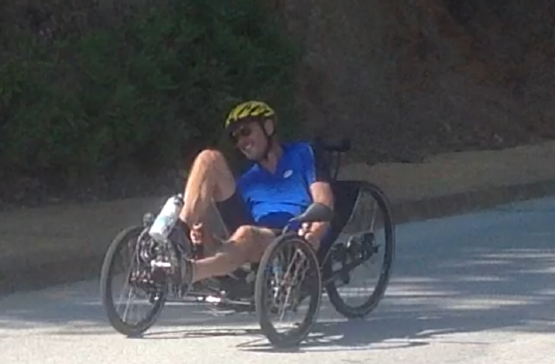
Travel far, fellow trike nomads! Adventure awaits – explore your planet on a trike.
* * * * * * *
A very inspirational overland trike journey across the Himalayas:
* * * * * * *
To visit Trike Hobo’s movie page, please click HERE.
* * * * * * *
ONLY A MILE
Speed and distance on a tricycle are profoundly different than speed and distance in the traditional transportation modes of affluent first-world countries, namely petroleum powered automobiles. On a trike, miles are not aspects of the trip that blow by as indifferent blurred visions outside of glass windows, not simply progress markers mentally dulled by the extreme speed of climate controlled convenience. Only a mile? Sixty miles every hour? Five hundred miles each day? Only a mile!
Well, on a human powered recumbent tadpole tricycle, a mile is a thing of beauty, a long and intimate mingling with the natural world not even remotely possible for the steel box dwellers from the land of modern expectations. Indeed, a mile is a memorable place in time for the overland triker, often experienced on challenging ascents as personal struggles upon the landscape, where blades of grass, fields of flowers, and whispering pines gently swaying in the wind remind the three wheeled nomad of the connections of all life on our tiny fragile planet. Sixty miles in one day? Quite an achievement!
There is the sound of the triker’s breath, the noise of the chain sliding through the tube, and the sights of nature in every plane and angle of vision. A journey through overland territories teaches the tired triangular traveler what a mile truly is. Trike phantoms are humbled by every mile that passes beneath their trio of tires. Each mile, only a mile, is a small victory of sorts as the journey, the adventure, the odyssey unfolds slowly in a manner invisible to humans powered by petroleum.
Only a mile, you ask? Any seasoned trike gypsy knows very well what a mile is, and knows to never take one for granted. Each and every mile tells a story, holds an entire epic adventure within its 5,280 feet. Yes, it may be only another dull blurred highway marker for those in the boxes, but for us on the tricycles, it is what life is all about.
Click image above to visit Trike Hobo’s YouTube page.
~
Learn all about Fatrikes by clicking the following image:

 Mark Waters of Bend, Oregon, rides a Greenspeed tadpole tricycle cross country. Below is a brief story by his triking partner Paul Carew about this fun overland journey to give you the flavor of what is possible on human powered recumbent tadpole tricycles:
 ICE and Greenspeed trikes, parked in the wilds for the night’s camp
 Early morning frost on Paul’s fairing – eastern Oregon gets cold at night!
 The gorgeous autumn colors of October in eastern Oregon take one’s breath away!



 Travel far, fellow trike nomads! Adventure awaits – explore your planet on a trike.
 Click image above to visit Trike Hobo’s YouTube page.


 Trike Asylum
You must be logged in to post a comment.